
 Austria
 Belgium
 France
 Germany
 Italy
Italy Netherlands
 Poland
 Spain
Spain Sweden
 United States
For a UK business opening up other European markets, a local phone number is one of the first things a prospect in that country checks before deciding to call you, yet the number you can actually publish there is not entirely your choice. Each European country regulates its own numbering plan through a national telecom authority, and that regulator sets the conditions a business has to meet before a local number can be assigned to it. Those conditions vary far more than most companies expect, so a plan that works for a German number can fail for a French one, and a document set that satisfies the Netherlands is not what Italy asks for.
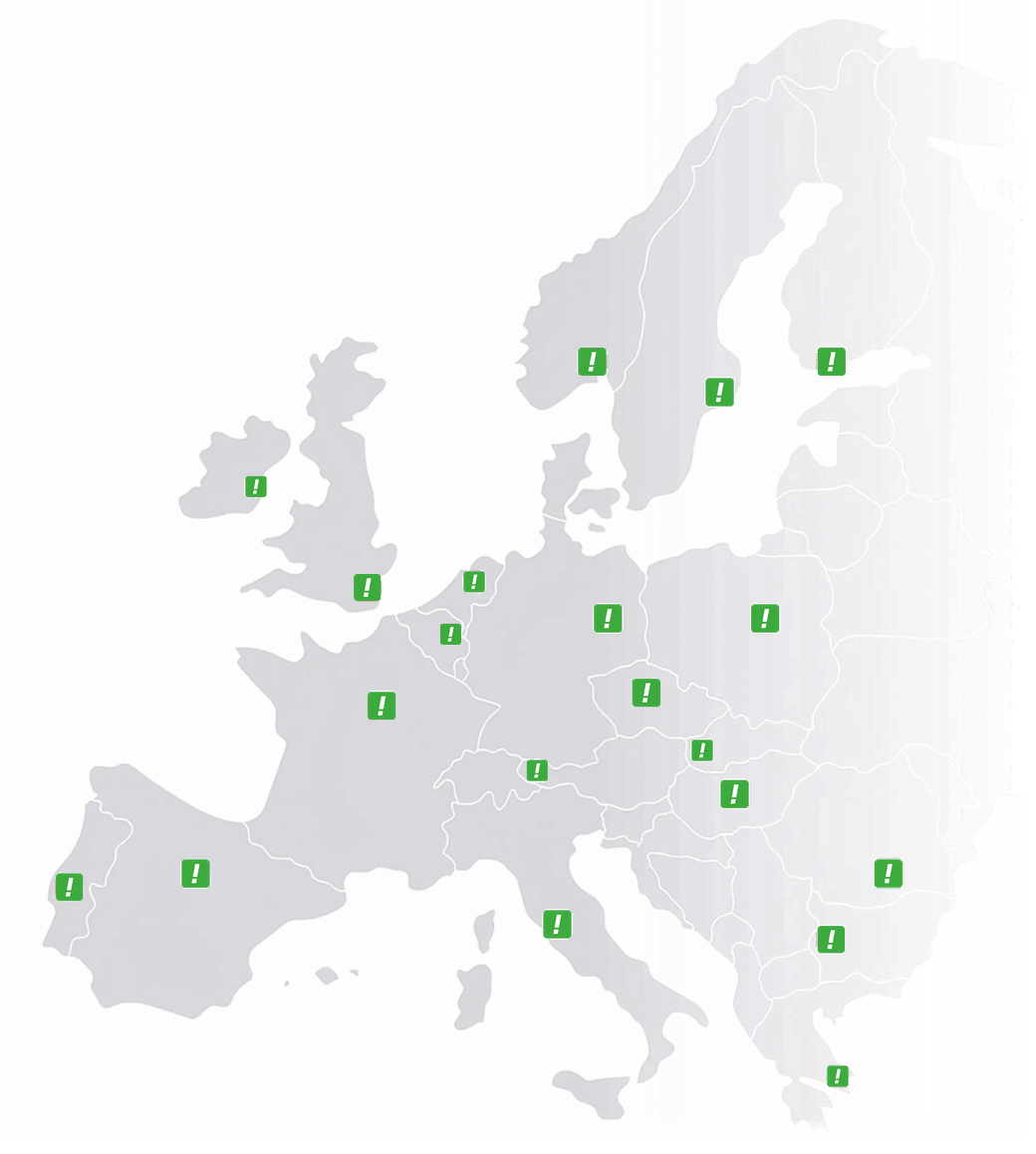
Knowing the rule for each market before you order saves weeks of back-and-forth and avoids ordering a number you do not qualify to hold. This guide sets out, country by country, who can register a local number and what the regulator requires, starting from the one distinction that explains most of the differences. Throughout, the registration itself is handled by a licensed operator; CallFactory is registered as a telecom operator in 14 European countries and files each registration in the format that country’s law requires, so you supply the documents once and the regulatory side is taken care of.
The distinction that drives every rule: geographic versus national and toll-free
Almost every national rule turns on the type of number. Geographic numbers, the ones tied to a city or region such as a Paris, Berlin or Amsterdam line, usually carry the strictest conditions, because regulators treat them as a signal that the holder has a real presence in that area. National numbers, which cover a whole country without pointing at a city, and toll-free numbers, where the called party pays, are treated more loosely in most markets, so they tend to register on the holder’s own company address regardless of where that company sits.
This is why the same provider can offer you a national number in a country within a day while a geographic number in the same country takes longer and asks for more paperwork. It also explains why the honest answer to “can my business get a number there” is often “yes for one type, no for another.” The sections below follow this split, beginning with the markets where a geographic number requires a genuine local footing.
Countries that require a local establishment or address
France is the strictest of the major markets. ARCEP applies a territorial link, the lien territorial, to every +33 number, so the number must be registered to a French establishment. You provide a French address, an extrait Kbis, which is the French company registration certificate, and a SIRET number that identifies the establishment. A company registered in France, or operating a French establishment, can then route the calls to a team anywhere, while a company with no French registration cannot meet the condition at all. There is no worldwide-address route into a +33 number.
Germany ties its geographic numbers to the area through the Ortsbindung principle, enforced by BNetzA. A geographic German number needs a German business address that genuinely belongs to the area code, established through a branch, a Handelsregister entry or a registered office there. National numbers and 0800 toll-free numbers are exempt from that local condition, so they register on your own company address. Spain works on the same logic through the CNMC: a geographic 9xx number needs the end user’s registered place of business in that province, whereas Spanish national numbers register on the company’s own address in any country.
Austria, regulated by RTR and KommAustria, ties a national number to an end-user location within Austria and a geographic number to an address that matches the area code, and it asks for valid proof of identity together with proof of address at the location. Italy, under AGCOM, lets toll-free numbers register on a worldwide address, while a geographic Italian number for a business needs the company name, address and VAT number plus an authorised representative’s identity, meaning their name, address, place and date of birth, nationality and tax code, with an ID or passport copy kept current. Switzerland sits outside the EU and is regulated by BAKOM: toll-free Swiss numbers accept a worldwide address, but every other Swiss number, geographic and national alike, needs a Swiss address the customer provides, with geographic numbers tied to the matching zone.
Countries where any business address works
Not every market asks for a local footing. The United Kingdom, regulated by Ofcom, lets any number register on the customer’s own address in any country, with no local establishment and no in-zone address required. For a business expanding from abroad, it is the simplest market to enter, because a single company registration document supports the application and a geographic city number is available on the same terms as a national one. The Czech Republic, regulated by the ČTÚ, follows the geographic split instead: a toll-free 800 number accepts a worldwide address, whilst a geographic number requires the end user’s location, a place of residence or business, within the number’s geographic zone.
The Netherlands sits in between, which makes it worth stating precisely. A geographic 0xx number, such as an Amsterdam 020 line, carries a vestigingseis, so it needs the customer’s address inside that numbering zone. Dutch national numbers in the 085 and 088 ranges, along with 0800 toll-free numbers, register on the customer’s own address in any country. So a company abroad can hold a Dutch national presence immediately, while a specific-city Dutch number depends on having an address in that zone. The pattern across Europe is consistent once you see it: national and toll-free ranges open to foreign businesses, geographic numbers gated by a local-presence test that a handful of countries apply strictly.
What you actually provide, and what the operator does with it
In every market the registration rests on traceability. The regulator wants to know who holds a number and where the registered subscriber sits, so that it, and emergency services, can identify the holder when needed. That is why the documents asked for are company-registration and address records rather than anything technical, and why they have to be kept current while the number is in use. For a worldwide-address number that means your standard company registration and address, and for a local-establishment number it means the local document set described above, such as the French Kbis and SIRET or the German Handelsregister entry.
Once you hand those over, the filing is the operator’s job. As the licensed operator, CallFactory prepares each registration in the format the national law requires, stores the subscriber data, and produces it to the regulator or emergency services on request, so the compliance side does not land on your desk. Because CallFactory runs its own platform and IVR and voicebot tools, any later change is handled directly by the team that runs that platform. Calls on the registered number then ride a premium fixed-network routing path, so the local presence you have registered for also sounds like a domestic line to the people who call it.
How to register a number in the market you want
The practical path is short once you know the rule. You decide which country and number type fit your market, confirm with us whether that number needs a local establishment or accepts your own company address, and gather the matching documents. CallFactory files the registration and activates the number, usually within a working day once the paperwork is complete, and you name the destination where the calls should land. From there the call-forwarding setup routes every inbound call to your team wherever it works, while the caller experiences a local contact in their own country.
To start, choose the market on the phone-numbers overview, or go straight to the country you need, such as France, Germany, the Netherlands, Spain, Italy, the United Kingdom, Austria, Switzerland or the Czech Republic. Tell us the number you want, and we confirm what that specific market requires before anything is ordered.