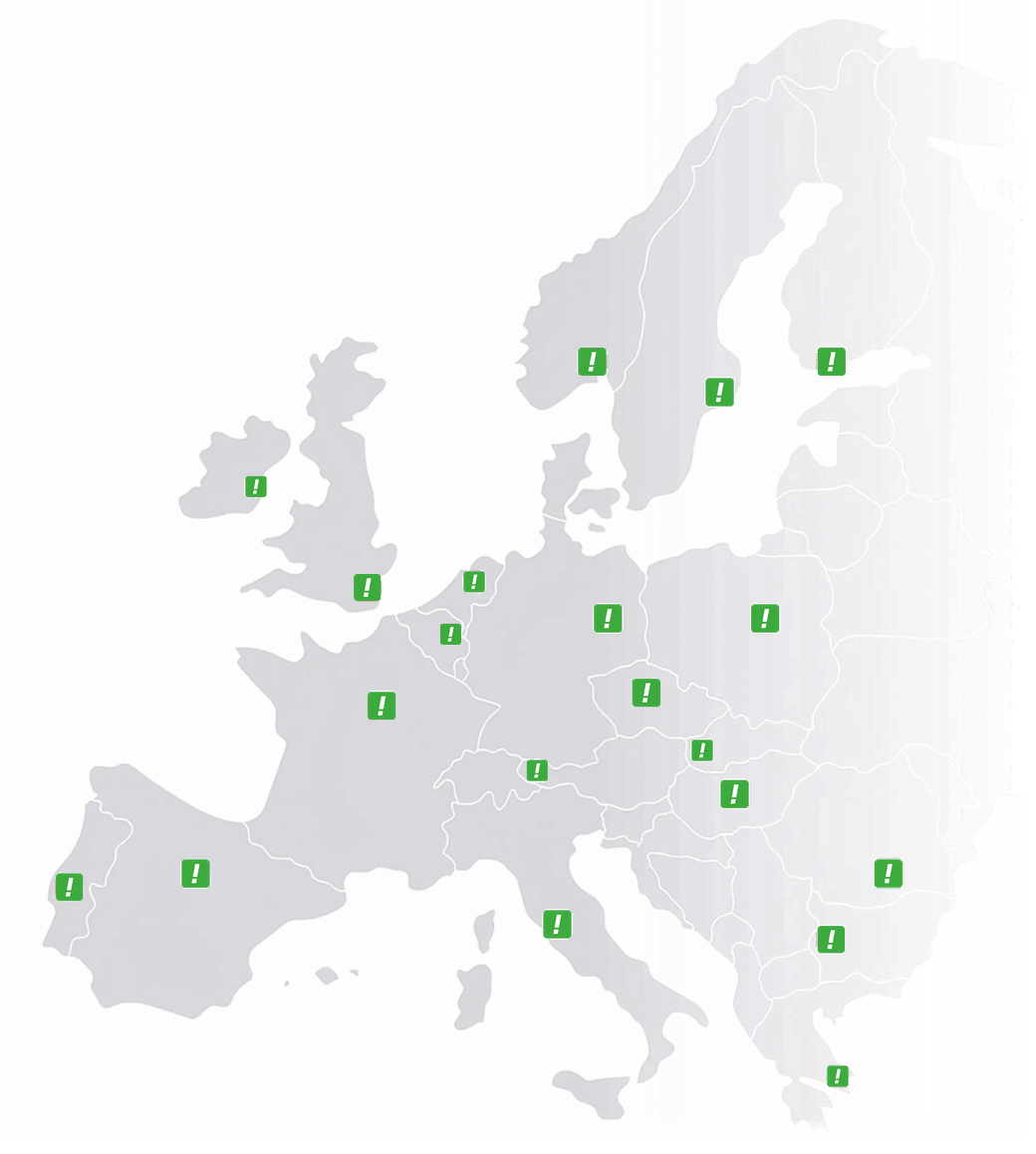

 Austria
 Belgium
 France
 Germany
 Italy
Italy Netherlands
 Poland
 Spain
Spain Sweden
 United States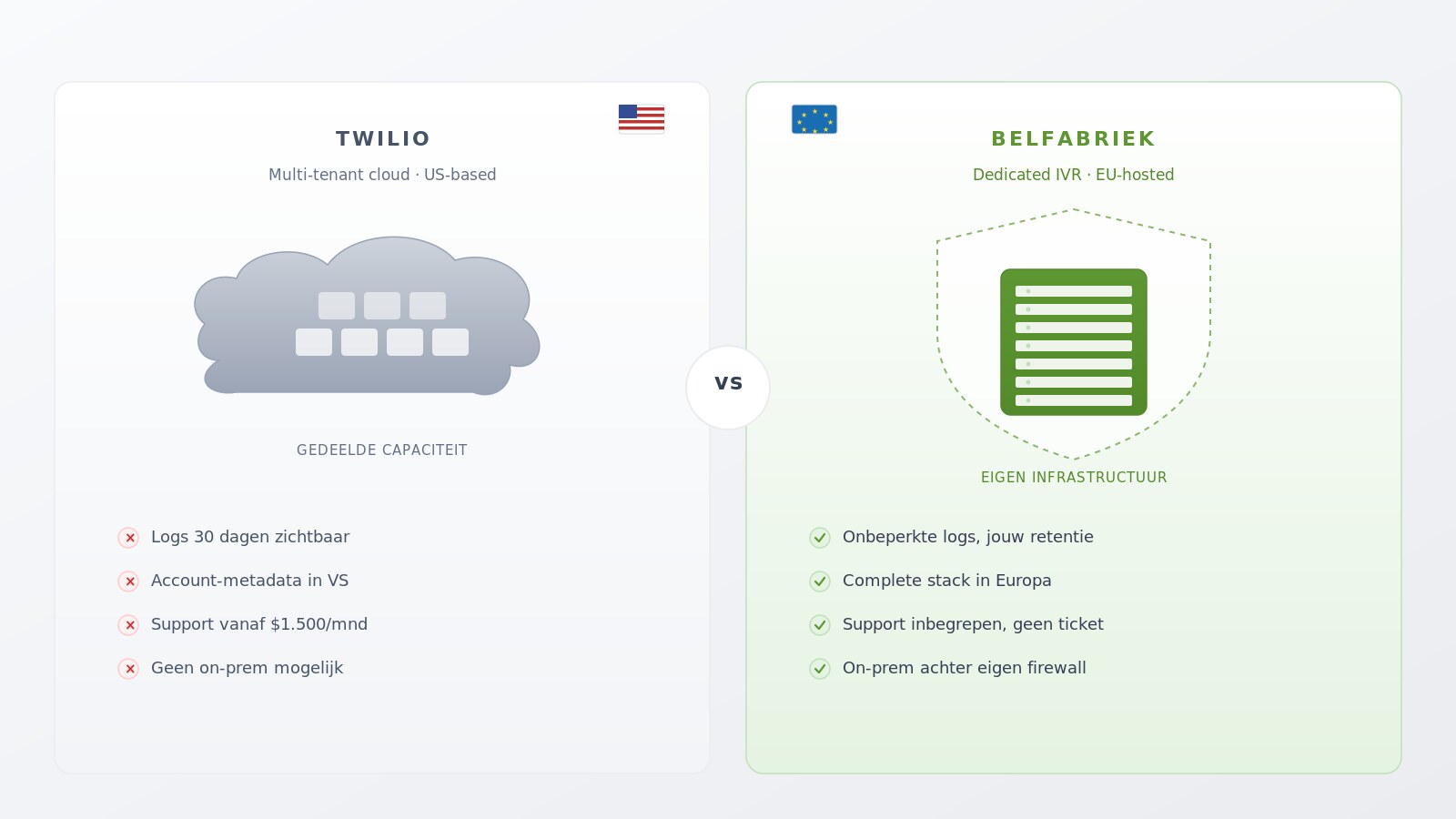
Many European businesses that build a call routing or voice application start with Twilio. The API is well known, the documentation is comprehensive, and you have something working within an hour for a proof of concept. Only later, when the application runs in production and the business becomes dependent on reliability, do the limits of a shared American cloud become visible. That is when you notice a missing piece in the logs is impossible to find because retention falls away after thirty days, that part of your account data is processed outside Europe despite the Ireland region for voice, or that the system simply cannot run behind your own firewall whilst your compliance team expects it. For those situations, CallFactory delivers an alternative that behaves differently on three fronts: full control over logs, full EU data processing and human support without thousands of pounds per month in extra costs.
Full logs and full control
The first break with an API-only platform usually happens when something goes wrong and nobody can pin down exactly where. Twilio’s Debugger retains alerts and errors for thirty days, Voice Insights retains call data for thirty days, and the call logs with TwiML request and response are gone after the same period. Anything older than that, you must have already written away yourself at the time it happened. Within that thirty-day window you also only see what Twilio decides to show on the outside of the media stack as a customer, which means you never reach the underlying media events or SIP signalling.
On a dedicated IVR server from CallFactory, it is the other way around. The server runs exclusively for your business, which means you log every event in the call lifecycle yourself, as deeply and as long as you need. An audit request from a year ago is simply a query against your own logs. A regression test after a release compares actual behaviour with behaviour, not a summary with a summary. You do not need to convince a vendor to open an internal dashboard because you control the dashboard yourself and decide which data you keep and for how long.
European infrastructure without caveats
For a British business, data residency is rarely an abstraction. A customer audit, a DPIA or a compliance requirement from the sector asks concretely where which data is processed. Twilio made a voice region in Ireland generally available in December 2021, which means call recordings, transcriptions, time stamps and duration are processed within the EU. The documentation, however, is clear about the rest of the picture: all other data about your account and use of the services is still processed in the United States. So your call itself sits in Ireland, but account metadata, configuration, console activity and a substantial part of operational data leave the EU.
For some regulators, that is sufficient; for the businesses that take this consideration seriously, it usually is not. CallFactory runs the entire stack in Europe, with the platform itself, the dedicated server, the recordings, the logs and administrative data all sitting within the same legal space as the contract and customer. There is no caveat in the residency story, which means a DPIA conducted against the CallFactory piece is airtight in one glance.
The ideal starting point for voice AI
A growing group of European businesses is making the step towards voice AI in 2026: a customer call handled in real time by a speech model, an automatic appointment assistant that works entirely in English, or first-line support that resolves straightforward questions independently. For those applications, everything hinges on the coupling between the telephony layer and the AI platform, with latency, audio quality and the freedom to switch between models being crucial to how natural the final call feels. A generic API that standardises around a fixed list of providers pinches exactly when you need freedom the most.
A dedicated IVR server is a natural starting point for this. The server opens a direct real-time connection to the AI endpoint of your choice, such as OpenAI, Azure, Google, Deepgram or ElevenLabs, and streams audio without intermediate layers, which keeps response time within the margin that natural conversation requires. Because the server runs exclusively for your business, you can experiment simultaneously with multiple models and decide per use case which model works best for which situation. For a business now setting up a voice AI pilot and wanting to scale to production within two years, that arrangement avoids the scenario where technical choices from the pilot must be remade later on different infrastructure.
Behind your own firewall for compliance and privacy
For banks, government agencies and healthcare organisations, the question is often sharper than “where does the data sit”: the system must run within your own network, so audio never leaves the perimeter. This requirement becomes more pressing as voice AI is deployed more seriously, because customer calls are then streamed in real time to a speech model and there is a moment when the full call content passes the vendor. Twilio has Interconnect, a solution for private connections between customer infrastructure and the Twilio cloud, but the actual call processing, recording and media stack remains with Twilio. There is no self-hosted edition that fits behind a firewall.
A dedicated IVR server from CallFactory can be rolled out within your own data centre or private cloud. The server then builds the connections itself to the AI endpoints you choose, whilst you decide which traffic leaves the perimeter and which stays inside. For a bank automating voice identification, or a local authority deploying a first-line assistant without citizen calls landing on an American cloud, that is the difference between a project that clears compliance and one that stays on the drawing board.
Support that rings you instead of tickets you buy
Twilio operates a support pricing model that often surprises European businesses. The free tier offers no guarantees. Production support starts at 4% of your monthly usage or 250 US dollars per month, whichever is higher. Business support, with 24-hour availability and a one-hour response time on critical incidents, starts at 6% of your usage or 1,500 US dollars per month. Personalised support, with a dedicated technical account manager and an escalation line, starts at 8% or 5,000 US dollars per month. For a business running ten or twenty thousand pounds per month in usage, that is a substantial sum for what is ultimately an upgrade to ticket handling.
At CallFactory, you simply call Britain. For the entire product suite, from numbers and IVR through dedicated server and private API, there is no separate support tariff layer. It is not included as a marketing promise, but as the way we work: because we build the platform ourselves, we know which layer the fault sits in and can look along with you in the call flow during the conversation.
When Twilio is actually the logical choice
Twilio is not the wrong choice for everything. For worldwide SMS A2P at large scale, for teams already anchored in the Twilio ecosystem with Segment and Flex, and for generic CPaaS breadth over deep control of the telephony layer, Twilio remains a reasonable platform. The comparison in this blog applies specifically to voice applications in Europe where logs, data residency or on-premise requirements play a role, and where a private API or dedicated infrastructure has concrete grounds.
What you concretely get at CallFactory
You get a private REST API with endpoints built for your use case, combined with an IVR platform we manage ourselves and on which we build custom flows to your specification. For applications that grow beyond that, we deliver a dedicated IVR server, rolled out within one working day for standard configurations and after a strategy session for more complex setups. The server works with every British phone number and every international phone number, runs optionally behind your own firewall, and logs every event you need for audit or debug.
Are you considering Twilio for a new project or running into the limits of an existing integration? Book a free strategy session and bring the use case with you. We will look together at whether a private API or a dedicated IVR server is the right starting point, and which trade-offs apply to your compliance and volume profile.